

AIA JUSTICE
A global dispute-resolution platform that resolves civil cases in days through AI judgment informed by every jurisdiction's laws, a human validator network, and a public Justice Score.

Justice delayed, is justice denied.

AI judgment, informed by the laws of every jurisdiction.
AIA Justice resolves civil disputes through two layers: an AI engine trained on active statutes, regulations, and procedural standards across jurisdictions, and a tiered network of human validators who review every outcome. Every account - whether individual, business, or validator - is KYC-verified.
Cases close with a reasoned verdict, a public record, and a Justice Score adjustment on both parties. The platform operates alongside existing legal and commercial frameworks.
Why justice systems struggle today.
Traditional justice systems were not designed for the speed, scale, and cross-border nature of modern digital interactions. Most civil disputes in a cross-border digital economy are either unaffordable to litigate, too slow to be worth it, or jurisdictionally out of reach. Power, capital, and procedural friction decide who gets heard.
That gap is where AIA Justice operates - making civil dispute resolution reachable, enforceable through transparent reputation, and scalable across jurisdictions without requiring treaty harmonisation.

How AIA Justice works.
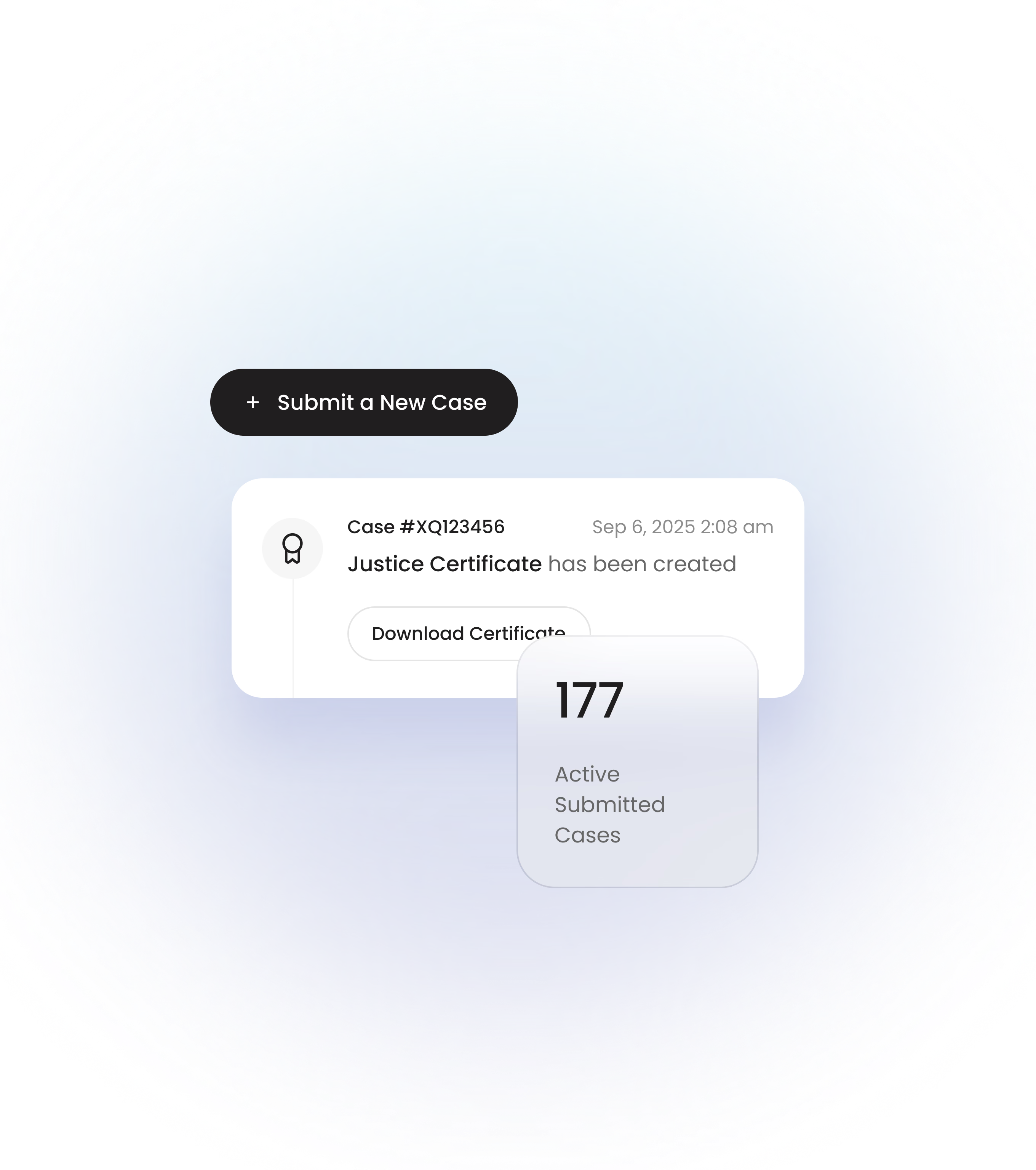
Filing a case takes minutes. File the claim and evidence - documents, communications, contracts or media - for a flat fee. The counterparty is notified automatically and has 24 hours to respond: defend, accept a proposed settlement, or ignore. Every response path affects the Justice Score.
AIA evaluates the case against applicable law and produces a reasoned verdict. A human validator then reviews the outcome. The case closes with a public record, a Justice Certificate, and the Justice Score moves.
The framework applies to private, commercial, and cross-border civil disputes - the same flow whether the claim is an unpaid invoice, a breached contract, or a cross-border supply disagreement.
AI judgment, informed by the laws of every jurisdiction.
AIA Justice resolves civil disputes through two layers: an AI engine trained on active statutes, regulations, and procedural standards across jurisdictions, and a tiered network of human validators who review every outcome. Every account - whether individual, business, or validator - is KYC-verified.
Cases close with a reasoned verdict, a public record, and a Justice Score adjustment on both parties. The platform operates alongside existing legal and commercial frameworks.
Why justice systems struggle today.
Traditional justice systems were not designed for the speed, scale, and cross-border nature of modern digital interactions. Most civil disputes in a cross-border digital economy are either unaffordable to litigate, too slow to be worth it, or jurisdictionally out of reach. Power, capital, and procedural friction decide who gets heard.
That gap is where AIA Justice operates - making civil dispute resolution reachable, enforceable through transparent reputation, and scalable across jurisdictions without requiring treaty harmonisation.
How AIA Justice works.
Filing a case takes minutes. File the claim and evidence - documents, communications, contracts or media - for a flat fee. The counterparty is notified automatically and has 24 hours to respond: defend, accept a proposed settlement, or ignore. Every response path affects the Justice Score.
AIA evaluates the case against applicable law and produces a reasoned verdict. A human validator then reviews the outcome. The case closes with a public record, a Justice Certificate, and the Justice Score moves.
The framework applies to private, commercial, and cross-border civil disputes - the same flow whether the claim is an unpaid invoice, a breached contract, or a cross-border supply disagreement.
Technology
Architecture
AIA Justice operates on a structured resolution architecture designed for civil dispute handling at scale.
The system evaluates claims, evidence, and responses through standardised logic - producing outcomes that are consistent across cases, explainable on demand, and auditable end-to-end.

Multimodal evidence processing
The platform ingests documents, text, audio, visual material, metadata, and interaction records into a single evidentiary model.
Each input is weighed across four dimensions - factual content, timing, interaction pattern, and obligation structure - the same dimensions a trained legal mind would apply, at machine speed.
The Case Matrix
At the core of AIA Justice is the Case Matrix, a structured model that maps claims, responses, obligations, and timelines into one logical framework.
The matrix updates as new evidence arrives, surfaces inconsistencies and dependencies, and preserves a complete audit trail from filing to verdict.
Execution Phases
 Completed
The core engine. Civil disputes evaluated through structured logic and evidence-based analysis, producing clear, auditable outcomes.
On Stage
A human validation layer that reviews and confirms resolutions where escalation is required, providing oversight, consistency, and procedural integrity.
A public reputation score from 0 to 100, assigned to every account on AIA Justice. Shaped by verdicts, procedural behaviour, and post-decision compliance. Visible to anyone.
Expansion across platforms, industries, and regions - toward a global standard for digital-first civil justice.

Integrated into the AIA Orbis infrastructure.
Operating as a native component of AIA Orbis, one intelligence architecture spanning dispute resolution, sovereign enterprise AI, social interaction, and physical robotics.
The Vision
Submit investor interest.
Explore AIA Orbis investor relations and the roadmap behind AIA Justice.
Get access